> ## Documentation Index
> Fetch the complete documentation index at: https://developer.box.com/llms.txt
> Use this file to discover all available pages before exploring further.
# Metadata
export const Link = ({href, children, className, ...props}) => {
const localizedHref = localizeLink(href);
return
{children}
;
};
Metadata allows users and applications to define and store custom data
associated with files and folders.
Metadata consists of key/value pairs that are assigned to a file or a folder.
For example, an important contract may have the key/value pairs of
`clientNumber: 820183` and `clientName: bioMedicalCorp`.
## Metadata terminology
Working with metadata requires a developer to work with a few
distinct types of resources.
* **Templates:** A metadata template describes a re-usable set of key/value pairs that can be assigned to a file. For example, an `invoiceData` template might hold data about an invoice, having a field for the invoice ID as well as the customer ID.
* **Fields:** A metadata template field describes a specific piece of data within a metadata template. For example, the ID of an invoice might be represented as an `id` field on an `invoiceData` template.
* **Instances:** A metadata instance describes the relation between a template and a file or folder, including the values that are assigned for every field. For example, a user might have assigned an `invoiceData` metadata template to a file and provided 2 values, one for the invoice ID and one for the customer ID. You can assign up to 100 templates to specific file or folder.
* **Cascade Policies**: A metadata cascade policy describes how metadata instances applied to a folder should be applied to any item within that folder. For example, a user might assign the same `invoiceData` metadata template to a project folder (including the 2 values), allowing them to automatically apply to all the files and folders within that project folder.
* **Queries:** A metadata query provides a way to find files and folders by searching for the metadata attached to them. For example, to find all the files for an invoice with a certain ID, the query would look for all files and folders with the `invoiceData` template attached to it and a value of `id = :id`, where `:id` would be the value of the invoice.
## The purpose of metadata
Metadata can be used for many purposes. Enterprises may want to have a better
way to organize their digital assets for their marketing teams, or developers
may want to provide advanced content functionality such as facilitating
workflows or approvals.
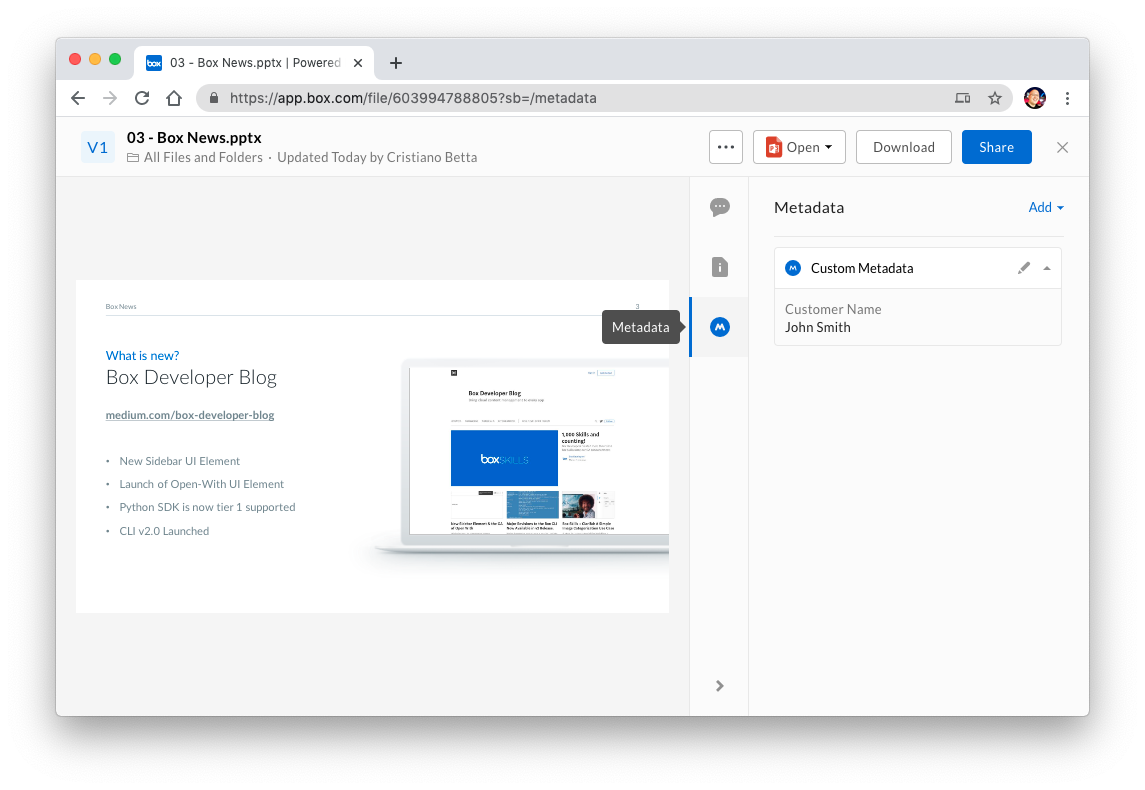
For example, a `marketingCollateral` template may define where and when specific
marketing content should be used. Users can see a representation of the
template in the Box web application while navigating to a file preview.
To learn more, please visit [Box community articles][community].
[community]: https://support.box.com/hc/en-us/articles/360044196173-Using-Metadata
 Metadata consists of key/value pairs that are assigned to a file or a folder.
For example, an important contract may have the key/value pairs of
`clientNumber: 820183` and `clientName: bioMedicalCorp`.
## Metadata terminology
Working with metadata requires a developer to work with a few
distinct types of resources.
* **Templates:** A metadata template describes a re-usable set of key/value pairs that can be assigned to a file. For example, an `invoiceData` template might hold data about an invoice, having a field for the invoice ID as well as the customer ID.
* **Fields:** A metadata template field describes a specific piece of data within a metadata template. For example, the ID of an invoice might be represented as an `id` field on an `invoiceData` template.
* **Instances:** A metadata instance describes the relation between a template and a file or folder, including the values that are assigned for every field. For example, a user might have assigned an `invoiceData` metadata template to a file and provided 2 values, one for the invoice ID and one for the customer ID. You can assign up to 100 templates to specific file or folder.
* **Cascade Policies**: A metadata cascade policy describes how metadata instances applied to a folder should be applied to any item within that folder. For example, a user might assign the same `invoiceData` metadata template to a project folder (including the 2 values), allowing them to automatically apply to all the files and folders within that project folder.
* **Queries:** A metadata query provides a way to find files and folders by searching for the metadata attached to them. For example, to find all the files for an invoice with a certain ID, the query would look for all files and folders with the `invoiceData` template attached to it and a value of `id = :id`, where `:id` would be the value of the invoice.
## The purpose of metadata
Metadata can be used for many purposes. Enterprises may want to have a better
way to organize their digital assets for their marketing teams, or developers
may want to provide advanced content functionality such as facilitating
workflows or approvals.
For example, a `marketingCollateral` template may define where and when specific
marketing content should be used. Users can see a representation of the
template in the Box web application while navigating to a file preview.
To learn more, please visit [Box community articles][community].
[community]: https://support.box.com/hc/en-us/articles/360044196173-Using-Metadata
Metadata consists of key/value pairs that are assigned to a file or a folder.
For example, an important contract may have the key/value pairs of
`clientNumber: 820183` and `clientName: bioMedicalCorp`.
## Metadata terminology
Working with metadata requires a developer to work with a few
distinct types of resources.
* **Templates:** A metadata template describes a re-usable set of key/value pairs that can be assigned to a file. For example, an `invoiceData` template might hold data about an invoice, having a field for the invoice ID as well as the customer ID.
* **Fields:** A metadata template field describes a specific piece of data within a metadata template. For example, the ID of an invoice might be represented as an `id` field on an `invoiceData` template.
* **Instances:** A metadata instance describes the relation between a template and a file or folder, including the values that are assigned for every field. For example, a user might have assigned an `invoiceData` metadata template to a file and provided 2 values, one for the invoice ID and one for the customer ID. You can assign up to 100 templates to specific file or folder.
* **Cascade Policies**: A metadata cascade policy describes how metadata instances applied to a folder should be applied to any item within that folder. For example, a user might assign the same `invoiceData` metadata template to a project folder (including the 2 values), allowing them to automatically apply to all the files and folders within that project folder.
* **Queries:** A metadata query provides a way to find files and folders by searching for the metadata attached to them. For example, to find all the files for an invoice with a certain ID, the query would look for all files and folders with the `invoiceData` template attached to it and a value of `id = :id`, where `:id` would be the value of the invoice.
## The purpose of metadata
Metadata can be used for many purposes. Enterprises may want to have a better
way to organize their digital assets for their marketing teams, or developers
may want to provide advanced content functionality such as facilitating
workflows or approvals.
For example, a `marketingCollateral` template may define where and when specific
marketing content should be used. Users can see a representation of the
template in the Box web application while navigating to a file preview.
To learn more, please visit [Box community articles][community].
[community]: https://support.box.com/hc/en-us/articles/360044196173-Using-Metadata